That first spoonful — the way the velvety broth coats your tongue before a briny hit of clam hits you — still takes me straight to a tiny seafood shack in Portland, Maine, where the fog was so thick you could barely see the harbor. I was seventeen, shivering in a borrowed raincoat, and that bowl of chowder rewired something in my brain. It wasn’t just soup; it was a warm blanket for your insides.
For years after that trip, I chased that exact flavor. I’d order chowder at every restaurant I visited, jotting down notes on napkins about what made each version sing or fall flat. Some were too thin, watery disappointments. Others were so thick with flour you could stand a spoon in them. A few were just… clam-flavored milk. But that perfect balance of creamy, smoky, and briny? That was harder to find than you’d think.
So I did what any obsessed home cook would do — I started making my own. This easy homemade New England clam chowder recipe is the result of about fifteen different batches, a few tears over broken emulsions, and one particularly memorable evening where I learned that burnt bacon fat ruins absolutely everything. It is the version I make when I’m homesick for a place that isn’t really home, when the weather turns mean, or when I just need something that feels like a hug in a bowl.
And honestly? It is simpler than you think. No fancy techniques, no hours of babysitting a pot. Just good ingredients and a little patience.
Why You’ll Love This Recipe
I have tested this chowder more times than I care to admit. Some batches were too salty, others not salty enough. One batch had clams that were tougher than shoe leather (lesson learned: do not boil them). But this version? This is the one I serve to guests without apology.
- Quick & Easy : Comes together in about 45 minutes, which is practically instant for a soup this deeply flavored. Perfect for those weeknights when you want something special but don’t want to spend all evening in the kitchen.
- Simple Ingredients : No weird fancy grocery store items here. Bacon, onions, potatoes, cream, clams — that’s it. You might need to grab some fresh clams or good canned ones, but everything else is probably already in your pantry.
- Perfect for Cozy Nights : This is the soup you want when the wind is howling and the rain is lashing against the windows. It is comfort food in its purest form, the kind that makes you want to curl up on the couch with a good book.
- Crowd-Pleaser : I have served this to seafood lovers and seafood skeptics alike, and it disappears every single time. There is something about that creamy, smoky broth that wins people over.
- Unbelievably Delicious : The texture is the real star here. Silky without being gluey, rich without being heavy. The bacon adds a smoky depth that plays perfectly against the sweet, briny clams.
This isn’t just another chowder recipe. It’s the one that uses a clever trick — blending a cup of the soup base before adding the cream — to get that velvety texture without a gallon of heavy cream. It is the version that respects the clams instead of drowning them. And it is the bowl that will make you close your eyes after the first bite, I promise.
What Ingredients You Will Need
This recipe uses simple, honest ingredients to build layers of flavor. Nothing complicated, just good stuff that works together.
- Bacon (6 slices, chopped) : The foundation of all that smoky goodness. I prefer a thick-cut bacon here — it renders more fat and gives you those nice meaty bits to chew on. Avoid maple-flavored bacon; you want straight-up smoky.
- Yellow onion (1 large, diced) : Sweet and mellow, the backbone of the flavor base. A Vidalia or sweet onion works great here too.
- Celery (2 ribs, diced) : Adds that subtle earthy note that stops the chowder from being one-dimensional. Don’t skip it.
- Garlic (3 cloves, minced) : Just enough to add depth without overpowering the delicate clam flavor. Fresh garlic is non-negotiable here.
- All-purpose flour (¼ cup) : Our thickener. It creates the roux that gives the chowder body. You can use a gluten-free flour blend if needed, but the texture will be slightly different.
- Chicken broth (2 cups) : Use a good quality low-sodium broth here. The clams will add plenty of salt, so you want to control the sodium level yourself. I like Better Than Bouillon for its rich flavor.
- Clam juice (1 cup) : This is liquid gold. It intensifies the briny flavor without needing to open a dozen more clams. You can find it near the canned tuna at most grocery stores.
- Russet potatoes (2 large, peeled and diced into ½-inch cubes) : Russets break down just enough to help thicken the chowder naturally. Yukon Golds work too, but they hold their shape a bit more.
- Fresh clams (2 pounds, scrubbed clean) OR canned chopped clams (3 cans, 6.5 oz each, drained with juice reserved) : Fresh clams give you that incredible briny liquor and tender texture. But honestly? Good quality canned clams work beautifully and save a ton of time. I use canned about half the time and don’t feel bad about it.
- Heavy cream (1 cup) : This is what makes it truly creamy. Do not substitute half-and-half here; the higher fat content is essential for that velvety texture and to prevent curdling.
- Fresh thyme (1 teaspoon, chopped) : A subtle herbal note that lifts the whole dish. Dried thyme works in a pinch, use half the amount.
- Bay leaf (1) : Adds background complexity. Remove it before serving.
- Salt and black pepper (to taste) : Go easy on the salt until the end. The bacon and clams bring plenty of their own.
- Fresh parsley (for garnish) : Not just for looks — it adds a fresh, bright finish that cuts through the richness.
- Oyster crackers (for serving) : Non-negotiable in my book. That salty, crunchy contrast is perfect.
Equipment Needed
You don’t need a professional kitchen to make this chowder. Here is what you will need:
- Large heavy-bottomed pot or Dutch oven : A 5-6 quart pot is ideal. The heavy bottom prevents scorching, which is a real risk with dairy-based soups. I use my trusty Le Creuset, but any heavy pot works.
- Sharp chef’s knife and cutting board : You will be doing a fair amount of dicing. A sharp knife makes the job infinitely easier and safer.
- Wooden spoon or silicone spatula : For stirring the roux and scraping up any browned bits from the bottom of the pot.
- Measuring cups and spoons : Precision matters, especially with the flour and cream.
- Immersion blender OR regular blender : This is for that secret step I mentioned. An immersion blender is easier — you just stick it right in the pot. A regular blender works too, just blend in batches and be careful with the hot liquid.
- Colander : For rinsing the canned clams if you’re using them, or for straining the fresh clam cooking liquid.
- Small bowl : For the flour slurry if you prefer that method over a roux.
If you don’t have an immersion blender, no worries. Just scoop out about a cup of the soup base (potatoes and all) into a regular blender, blend until smooth, and stir it back in. That is how I did it for years before I got my immersion blender.
Preparation Method
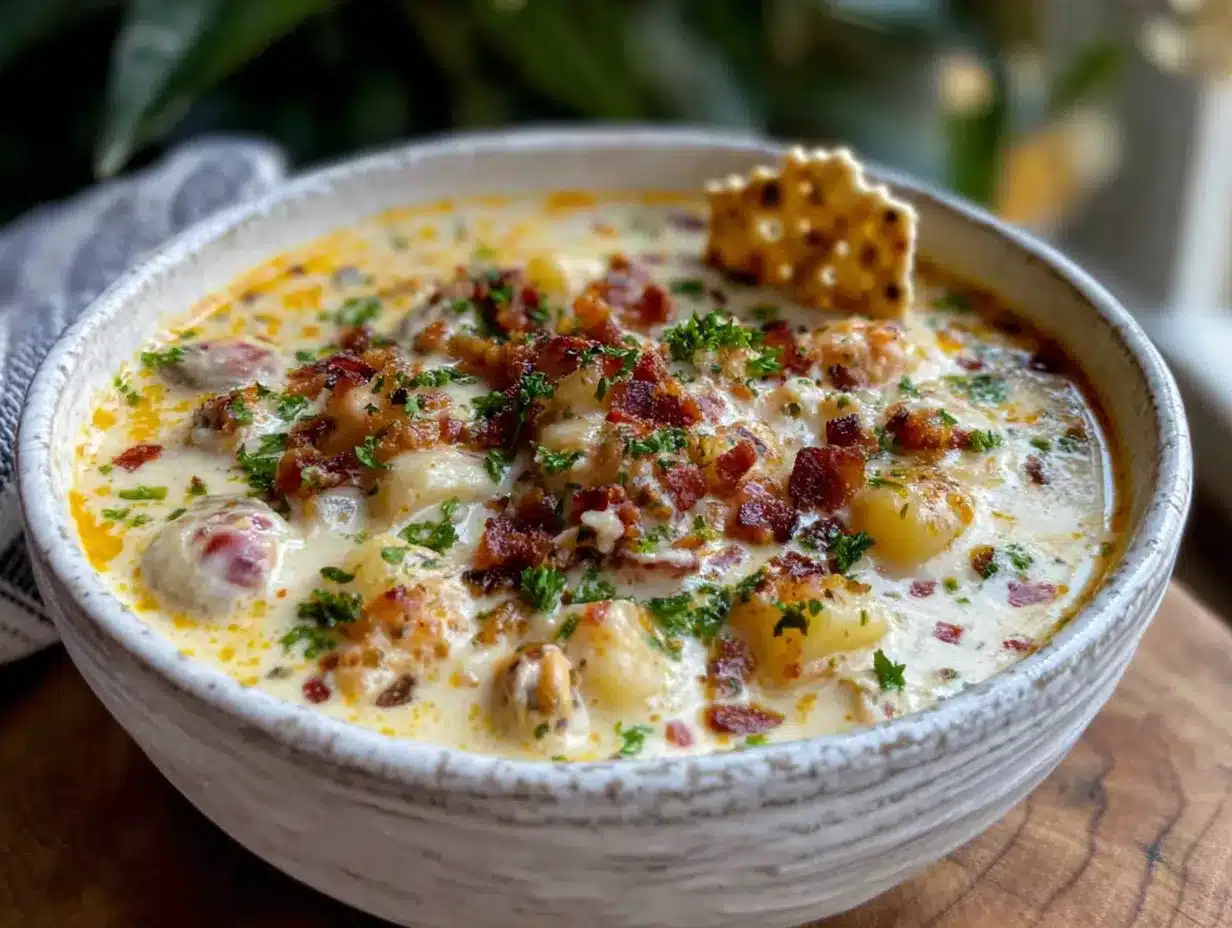
Alright, let’s make some chowder. Take your time with the first few steps — building a good base is everything here.
- Cook the bacon (8-10 minutes) : Place your chopped bacon in the cold pot and turn the heat to medium. Let it render slowly, stirring occasionally, until the bacon is crispy and the fat has rendered out. This takes about 8-10 minutes. Use a slotted spoon to transfer the bacon to a paper towel-lined plate, leaving the rendered fat in the pot. Do not skip this step — that bacon fat is flavor gold.
- Sauté the aromatics (5-7 minutes) : Add the diced onion and celery to the pot with the bacon fat. Cook over medium heat, stirring occasionally, until the onion is translucent and starting to soften, about 5 minutes. Add the minced garlic and cook for another minute until fragrant. You want the kitchen to smell amazing at this point. If it does, you are on the right track.
- Make the roux (2-3 minutes) : Sprinkle the flour over the sautéed vegetables and stir constantly for 2-3 minutes. This cooks the raw flour taste out and creates a smooth paste. The mixture will look a bit pasty and smell slightly nutty. Keep stirring — you don’t want it to brown, just to cook through.
- Add the liquids (5 minutes) : Slowly pour in the chicken broth while whisking constantly to prevent lumps. Then add the clam juice and stir until smooth. Bring this mixture to a gentle simmer — you will see small bubbles around the edges of the pot. It should thicken slightly.
- Add the potatoes and aromatics (15-20 minutes) : Add the diced potatoes, fresh thyme, and bay leaf to the pot. Stir everything together, reduce the heat to medium-low, and let it simmer gently until the potatoes are tender when pierced with a fork. This usually takes about 15-20 minutes. Do not rush this step — undercooked potatoes in chowder are a tragedy.
- The secret step (5 minutes) : Once the potatoes are tender, remove the bay leaf. Using an immersion blender, carefully blend about half the soup right in the pot — or scoop out 1½ cups of the soup base (potatoes and liquid) and blend it in a regular blender until smooth. Stir the blended mixture back into the pot. This gives you that luscious, velvety texture without needing a ton of cream. Trust me on this one.
- Add the clams and cream (5 minutes) : Reduce the heat to low. Stir in the heavy cream and the clams (both fresh cooked clams and their liquor, or the drained canned clams). Let everything warm through gently for about 3-5 minutes. Do not let it boil — high heat will make the cream curdle and turn the clams rubbery. You just want it hot and steamy.
- Season and finish (2 minutes) : Taste the chowder and season with salt and pepper. Remember that the bacon and clams are already salty, so go easy. Stir in the reserved crispy bacon, reserving a little for garnish if you want to be fancy. Remove from heat.
- Rest and serve (5-10 minutes) : Let the chowder sit off the heat for about 5-10 minutes before serving. This allows the flavors to meld and the texture to settle. Ladle into bowls, garnish with fresh parsley and a few bacon bits, and serve with oyster crackers on the side.
Cooking Tips & Techniques
I have made this chowder enough times to have a few battle scars. Here is what I have learned the hard way so you don’t have to.
Low and slow is your friend. The biggest mistake people make with clam chowder is rushing. High heat will curdle the cream, toughen the clams, and scorch the bottom of the pot. Keep everything at a gentle simmer — you should see small bubbles, not a rolling boil.
Salt strategically. I cannot stress this enough. Bacon, clam juice, and canned clams all contain significant amounts of salt. Season the chowder early with just a pinch, then taste and adjust at the very end. I once ruined an entire batch by salting too early — it was practically inedible.
The blending trick is non-negotiable. I know it seems like an extra step, but it is what separates a good chowder from a great one. Blending a portion of the potatoes creates a natural creaminess that lets you use less heavy cream. The result is a chowder that feels luxurious without being heavy.
Fresh vs. canned clams — the honest truth. Fresh clams are wonderful if you have access to good ones and have the time to scrub and steam them. But honestly? Good quality canned chopped clams (like Bar Harbor or Wild Planet) make an excellent chowder. The key is to use the juice from the cans as part of your liquid. Do not drain and rinse them; you want that briny goodness.
Let it rest. Chowder always tastes better the next day. The flavors have time to meld and deepen. If you can make it a day ahead, do it. Just reheat it gently over low heat, adding a splash of milk or cream if it has thickened too much.
Variations & Adaptations
This chowder is forgiving, and I have played around with it more times than I can count. Here are some variations I have tried and loved.
- Smoked Fish Chowder : Swap half the clams for flaked smoked haddock or trout. The smoky flavor deepens the whole dish. I did this on a whim one rainy Sunday and it was spectacular.
- Corn and Clam Chowder : Add 1 cup of fresh or frozen corn kernels along with the potatoes. The sweetness of the corn plays beautifully against the briny clams. This is my summer version when corn is at its peak.
- Dairy-Free Version : Use full-fat coconut milk instead of heavy cream and a good vegan butter instead of bacon fat. The coconut flavor is subtle and actually works surprisingly well with the clams. I have served this to dairy-free friends and they didn’t miss a thing.
- Spicy Kick : Add a pinch of red pepper flakes along with the garlic, or stir in a diced jalapeño with the onions. The heat cuts through the richness beautifully.
- Herb Swap : Try dill instead of thyme. Dill and seafood are a classic pairing, and it gives the chowder a bright, fresh note that is lovely in spring.
Serving & Storage Suggestions
This chowder is a meal in itself, but it plays well with others.
Serving suggestions: Serve piping hot in deep bowls with a generous handful of oyster crackers on top. A simple green salad with a lemony vinaigrette is the perfect side — the acidity cuts through the richness. For a heartier meal, serve alongside a crusty sourdough loaf for dipping. I also love it with a simple spaghetti aglio olio as a starter — the garlic and olive oil set the stage perfectly.
Storage: Let the chowder cool completely before storing. Transfer to an airtight container and refrigerate for up to 4 days. The flavors will actually improve after a day or two.
Freezing: You can freeze this chowder, but there is a catch. Cream-based soups can separate when thawed. If you plan to freeze it, leave out the cream and add it fresh when reheating. Freeze the base for up to 3 months.
Reheating: Reheat gently over low heat, stirring occasionally. Do not boil. If the chowder has thickened too much in the fridge, add a splash of milk or broth to thin it out. If you froze it, thaw overnight in the fridge, then reheat and stir in the cream at the end.
Nutritional Information & Benefits
This chowder is comfort food, so I am not going to pretend it is a health food. But it does have some redeeming qualities.
- Estimated per serving (based on 6 servings): Approximately 420 calories, 22g fat, 28g carbohydrates, 18g protein, 3g fiber, 780mg sodium.
- Clams are nutritional powerhouses: They are packed with iron, vitamin B12, and selenium. A single serving provides a significant portion of your daily iron needs.
- Potatoes get a bad rap: They are actually a good source of potassium, vitamin C, and fiber (especially if you leave the skins on, though I peel them here for texture).
- Dairy considerations: This recipe contains dairy and gluten. For a gluten-free version, use a 1:1 gluten-free flour blend for the roux. For dairy-free, see the variations above.
- My personal take: I believe in balance. This chowder is not an everyday meal, but it is perfect for those days when you need something deeply satisfying. A bowl of this with a side salad and you have a meal that nourishes both body and soul.
Conclusion
This easy homemade New England clam chowder recipe is the one I turn to again and again. It is the taste of foggy mornings on the Maine coast, of cozy dinners with friends, of those quiet evenings when you just need something warm and good. It is comfort food that doesn’t apologize for being comforting.
I hope you make this chowder and make it your own. Maybe you will add extra bacon (I certainly do sometimes). Maybe you will throw in some corn or a pinch of cayenne. That is the beauty of a good recipe — it gives you a foundation and trusts you to build on it.
If you love this, you might also enjoy a bowl of creamy tuna pasta for another quick, satisfying meal. And if you try this chowder, I would love to hear about it. Drop a comment below and tell me how it turned out, or share your own twist on it. That is how recipes live on — through all of us making them and passing them along.
Now go make some chowder. Your future self will thank you.
Frequently Asked Questions
Can I use frozen clams instead of fresh or canned?
Absolutely. Frozen clams work well in chowder. Thaw them in the refrigerator overnight, drain them (reserving the liquid), and add them to the pot in step 7 just like you would fresh or canned clams. The texture might be slightly softer, but the flavor will still be excellent.
Why did my chowder turn out grainy?
Grainy chowder usually means one of two things: the roux was not cooked long enough, or the heat was too high when you added the cream. Make sure you cook the flour for a full 2-3 minutes before adding liquid, and always add cream over low heat. Also, do not let the chowder boil after the cream goes in.
Can I make this chowder in a slow cooker?
Yes, with some adjustments. Cook the bacon and sauté the vegetables on the stovetop first, then transfer everything except the cream and clams to the slow cooker. Cook on low for 4-6 hours. Stir in the cream and clams during the last 30 minutes. The texture will be slightly different, but it works great for busy days.
How do I thicken my chowder without using flour?
You have a few options. You can mash some of the cooked potatoes against the side of the pot to release their starch. Or blend a cup of the soup base as I describe in the recipe. Another option is to stir in a tablespoon of cornstarch mixed with cold water at the end, but let it simmer for a few minutes to cook out the raw cornstarch taste.
Can I add other seafood to this chowder?
Definitely. Chopped cooked shrimp, scallops, or chunks of white fish like cod or haddock all work beautifully. Add them along with the clams in step 7. Just be careful not to overcook them — they only need a few minutes to heat through. I have made a seafood chowder version with clams, shrimp, and scallops that was absolutely divine.
Pin This Recipe!
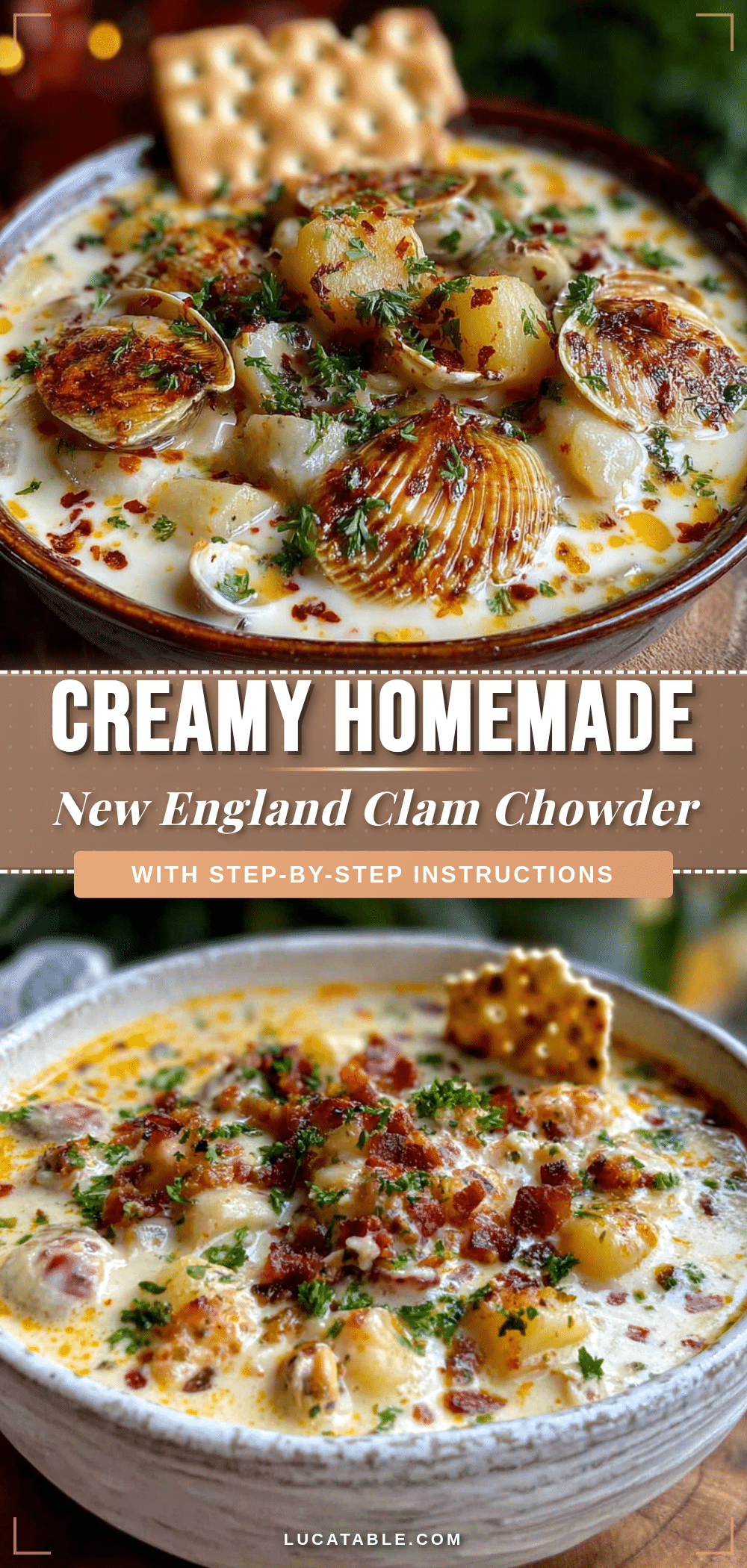
Easy Homemade New England Clam Chowder Recipe
A velvety, creamy New England clam chowder with smoky bacon, tender clams, and a secret blending trick for the perfect texture. This comforting soup comes together in about 45 minutes and is perfect for cozy nights.
- Prep Time: 15 minutes
- Cook Time: 30 minutes
- Total Time: 45 minutes
- Yield: 6 servings 1x
- Category: Soup
- Cuisine: American (New England)
Ingredients
- 6 slices bacon, chopped
- 1 large yellow onion, diced
- 2 ribs celery, diced
- 3 cloves garlic, minced
- ¼ cup all-purpose flour
- 2 cups chicken broth (low-sodium)
- 1 cup clam juice
- 2 large Russet potatoes, peeled and diced into ½-inch cubes
- 2 pounds fresh clams, scrubbed clean OR 3 cans (6.5 oz each) chopped clams, drained with juice reserved
- 1 cup heavy cream
- 1 teaspoon fresh thyme, chopped (or ½ teaspoon dried)
- 1 bay leaf
- Salt and black pepper to taste
- Fresh parsley for garnish
- Oyster crackers for serving
Instructions
- Cook the bacon: Place chopped bacon in a cold large heavy-bottomed pot or Dutch oven. Turn heat to medium and cook, stirring occasionally, until crispy (8-10 minutes). Transfer bacon to a paper towel-lined plate with a slotted spoon, leaving rendered fat in the pot.
- Sauté the aromatics: Add diced onion and celery to the pot with bacon fat. Cook over medium heat, stirring occasionally, until onion is translucent (about 5 minutes). Add minced garlic and cook for 1 minute until fragrant.
- Make the roux: Sprinkle flour over the sautéed vegetables and stir constantly for 2-3 minutes until a smooth paste forms and smells slightly nutty.
- Add the liquids: Slowly pour in chicken broth while whisking constantly to prevent lumps. Add clam juice and stir until smooth. Bring to a gentle simmer.
- Add potatoes and aromatics: Add diced potatoes, fresh thyme, and bay leaf. Stir, reduce heat to medium-low, and simmer gently until potatoes are tender when pierced with a fork (15-20 minutes).
- The secret step: Remove bay leaf. Using an immersion blender, blend about half the soup directly in the pot. Alternatively, scoop out 1½ cups of soup base (potatoes and liquid) and blend in a regular blender until smooth, then stir back into the pot.
- Add clams and cream: Reduce heat to low. Stir in heavy cream and clams (fresh cooked clams with their liquor or drained canned clams). Warm through gently for 3-5 minutes. Do not let it boil.
- Season and finish: Taste and season with salt and pepper. Stir in most of the reserved crispy bacon, reserving some for garnish. Remove from heat.
- Rest and serve: Let chowder sit off heat for 5-10 minutes. Ladle into bowls, garnish with fresh parsley and remaining bacon bits, and serve with oyster crackers.
Notes
For best results, do not let the chowder boil after adding cream to prevent curdling. Salt strategically as bacon, clam juice, and canned clams are already salty. The chowder tastes even better the next day. For freezing, leave out the cream and add it fresh when reheating.
Nutrition
- Serving Size: 1 bowl (about 1.5 cu
- Calories: 420
- Sugar: 4
- Sodium: 780
- Fat: 22
- Saturated Fat: 12
- Carbohydrates: 28
- Fiber: 3
- Protein: 18
Keywords: clam chowder, New England clam chowder, easy clam chowder, homemade clam chowder, creamy clam chowder, seafood soup, comfort food