The first real cold snap of November had settled in, and I had just pulled a third layer of blankets out of the closet. The kind of chill that seeps through windows and settles into your bones. I had a sad-looking chuck roast in the fridge, a half-empty bag of pearl barley, and absolutely no energy for anything complicated. I wanted something that would fill the house with that low, slow smell of dinner cooking itself. Something that wouldn’t require me to stand over a stove. So I tossed everything into the slow cooker—beef, barley, carrots, a few pantry staples—and let the afternoon do the work. That was the first time I made this poor man’s stew, and honestly, it felt less like cooking and more like coming home to something that had been waiting for me.
There’s a quiet satisfaction in making a meal that costs almost nothing but tastes like you fussed for hours. This isn’t a fancy dish. It’s not trying to impress anyone. It’s the kind of stew that fills your kitchen with steam and your belly with warmth, and it asks very little of you in return. The barley gets tender and almost creamy, the beef breaks apart with a fork, and the broth turns rich and savory without any heavy cream or complicated steps. It’s the meal you make when you need a win, not a project.
I’ve made this stew on repeat through three different winters now, and it’s become my go-to for those weeks when the budget is tight and the to-do list is long. It’s proof that you don’t need expensive ingredients or culinary tricks to eat well. Just a slow cooker, a little patience, and a few humble ingredients that somehow become something magical together.
Why You’ll Love This Recipe
I’ve tested this poor man’s stew more times than I can count, tweaking the broth ratio, playing with the barley cook time, and even accidentally burning a batch or two (don’t ask). What I landed on is a version that hits every single note I want from a comfort meal—without any fuss or fancy techniques.
- Budget-Friendly: This recipe uses affordable cuts of beef and pantry staples. You won’t need any specialty ingredients or expensive cuts of meat. It’s genuinely designed for a tight grocery week.
- Set It and Forget It: The slow cooker does all the heavy lifting. You’ll spend about 15 minutes prepping, then walk away for hours. Perfect for busy days when you want a hot dinner waiting for you.
- Deep, Rich Flavor: The barley releases starch as it cooks, creating a naturally thick and velvety broth. No flour, no cornstarch, no extra steps. It just happens on its own.
- Hearty and Satisfying: This isn’t a thin soup. It’s a thick, chunky stew that sticks to your ribs. One bowl and you’re genuinely full.
- Family-Approved: I’ve served this to picky eaters, hungry teenagers, and adults who claim they don’t like barley. Every single person has gone back for seconds. It’s one of those rare recipes that pleases everyone at the table.
- Makes Great Leftovers: The flavors actually get better overnight. This is one of those stews you’ll look forward to eating for lunch the next day.
What sets this recipe apart from other beef and barley soups is the texture. Most versions end up watery or the barley turns mushy. Through trial and error, I found the perfect ratio of liquid to barley and the ideal cook time to keep the grains tender but distinct. The beef, too—I use chuck roast cut into chunks, which breaks down into fork-tender bites after hours of gentle simmering. It’s not just another stew. It’s the stew I keep coming back to, winter after winter.
What Ingredients You Will Need
This recipe relies on simple, humble ingredients that work together to create something far greater than the sum of their parts. Most of these are pantry staples or easy to find at any grocery store. Here’s what you’ll need.
- Beef chuck roast (2 lbs or about 900g): This is my go-to cut for stew. It has enough marbling to stay tender during long cooking. Trim off any large pieces of fat, then cut it into 1.5-inch chunks. You can also use beef stew meat from the store, but I find chuck roast gives better flavor. (I usually buy from my local butcher when I can.)
- Pearl barley (1 cup or 200g): Pearl barley cooks faster than hulled barley and gives the stew that signature thick, almost creamy texture. Don’t substitute with quick-cooking barley here—it will turn to mush. Rinse it under cold water before adding to the pot.
- Yellow onion (1 large, diced): Adds a savory base note. I prefer yellow onions for their balanced flavor, but white onions work too.
- Carrots (3 medium, peeled and sliced into rounds): They add sweetness and color. I cut them into thick coins so they hold their shape during the long cook time.
- Celery (3 stalks, sliced): Adds that classic aromatic backbone. Don’t skip it—it adds depth you’d miss otherwise.
- Garlic (4 cloves, minced): Fresh garlic is non-negotiable here. Pre-minced jarred garlic just doesn’t deliver the same punch.
- Beef broth (4 cups or 960ml): Use a good quality low-sodium broth so you can control the salt level. I like Pacific Foods or Swanson’s unsalted version. If you only have salted broth, hold off on adding extra salt until the end.
- Water (2 cups or 480ml): Helps thin the broth just enough without diluting the flavor. The barley will absorb a lot of liquid as it cooks.
- Tomato paste (2 tablespoons): Adds richness and a subtle tang. It deepens the color of the broth and rounds out the savory flavors.
- Worcestershire sauce (1 tablespoon): Adds umami and a little tang. I’ve tried making this without it, and it’s just not the same. Lea & Perrins is my go-to brand.
- Dried thyme (1 teaspoon): Earthy and slightly floral. It pairs beautifully with beef and barley.
- Dried rosemary (½ teaspoon): Use less than thyme—rosemary can be overpowering. It adds a woodsy, aromatic note.
- Bay leaves (2): They add subtle depth during cooking. Remember to remove them before serving.
- Salt and black pepper (to taste): I start with 1 teaspoon of salt and ½ teaspoon of pepper, then adjust at the end. The barley absorbs salt as it cooks, so you might need more.
- Olive oil (2 tablespoons): For browning the beef. Use a neutral oil with a decent smoke point like avocado oil if you prefer.
- Fresh parsley (for garnish, optional): Adds a pop of color and freshness at the end. Totally optional but nice.
Equipment Needed
You don’t need a fancy kitchen to make this stew. Here’s what you’ll actually use.
- Slow cooker (6-quart or larger): A 6-quart model is ideal for this amount of stew. If yours is smaller, reduce the recipe by a third. I use a basic Crock-Pot brand model I’ve had for years—nothing fancy, but it gets the job done.
- Large skillet or Dutch oven: For browning the beef before it goes into the slow cooker. This step is crucial for flavor, so don’t skip it. A cast iron skillet works beautifully here.
- Cutting board and sharp chef’s knife: You’ll be doing a fair amount of chopping. A sharp knife makes prep faster and safer.
- Measuring cups and spoons: Standard set for liquids and dry ingredients.
- Wooden spoon or spatula: For stirring the browning beef and scraping up the browned bits from the skillet.
- Mixing bowl: For tossing the beef with salt and pepper before browning.
- Tongs: Helpful for turning the beef chunks as they brown. Less splashing than a fork.
- Ladle: For serving. A deep ladle works best for this thick stew.
If you don’t have a slow cooker, you can make this in a heavy-bottomed pot on the stovetop over low heat for about 2 to 2.5 hours. Just keep an eye on the liquid level and add more broth if needed. I’ve done it both ways, and honestly, the slow cooker version tastes more developed—probably because of the longer, gentler cooking time.
Preparation Method
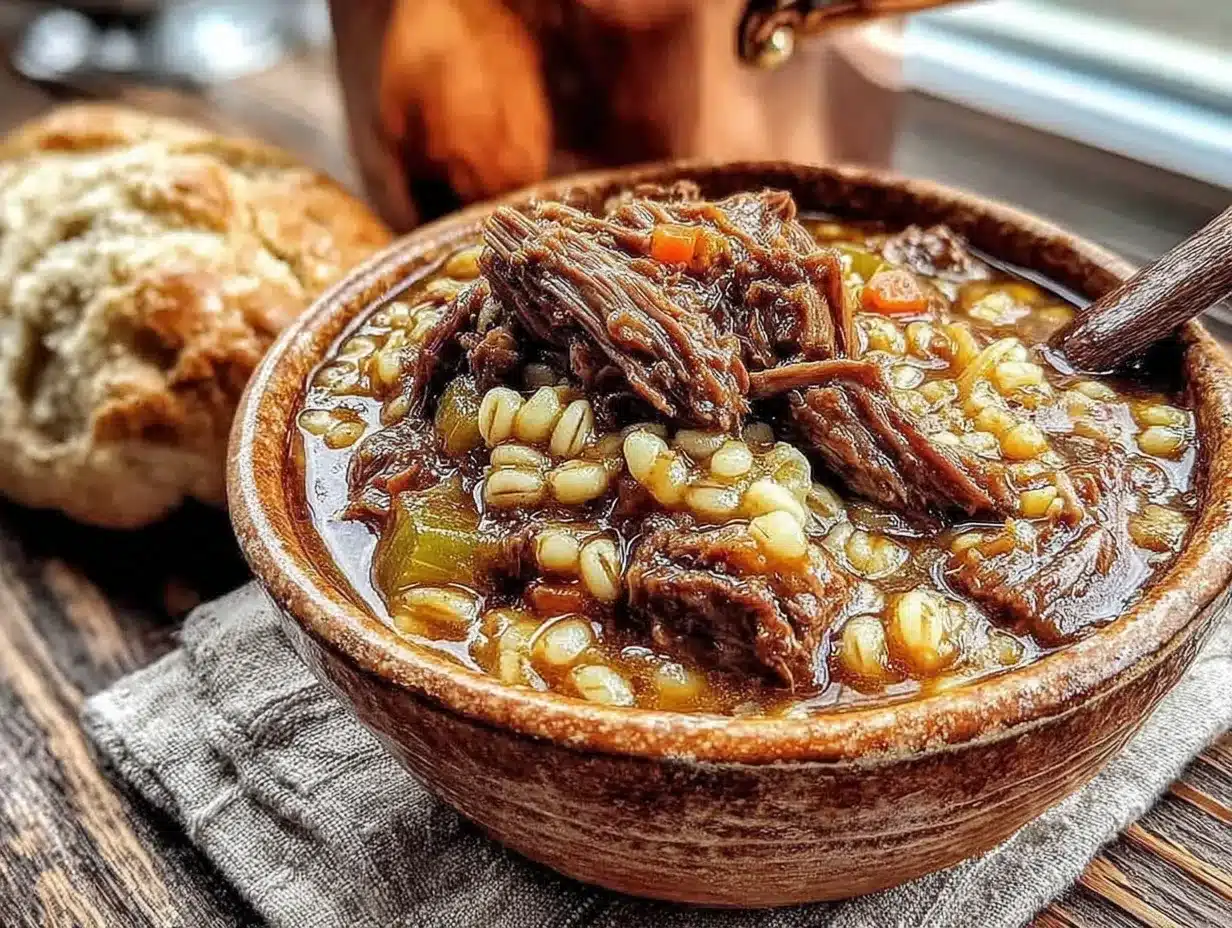
This recipe moves through a few simple stages. Take your time with the browning step—it’s where most of the flavor comes from. Everything after that is practically hands-off.
- Prep the beef: Pat the chuck roast dry with paper towels. This is important—wet beef won’t brown properly. Cut it into 1.5-inch chunks, trimming off any large pieces of silver skin or hard fat. Season the chunks generously with 1 teaspoon of salt and ½ teaspoon of black pepper. Toss to coat evenly.
- Brown the beef: Heat 2 tablespoons of olive oil in a large skillet over medium-high heat until it shimmers. Working in batches so you don’t crowd the pan (crowding causes steaming, not browning), add the beef chunks in a single layer. Let them sear undisturbed for about 3-4 minutes per side until a deep brown crust forms. Use tongs to turn them. Transfer the browned beef to the slow cooker. Don’t worry if some pieces aren’t perfectly browned on all sides—just do your best.
- Sauté the aromatics: Reduce the heat to medium. Add the diced onion to the same skillet (don’t wipe it out—those browned bits are pure flavor). Cook for 3-4 minutes, stirring occasionally, until the onion softens and turns translucent. Add the minced garlic and cook for another 30 seconds until fragrant. Scrape the bottom of the pan to release any stuck-on beef bits. Transfer everything to the slow cooker.
- Add the vegetables and barley: Add the sliced carrots, celery, and rinsed pearl barley to the slow cooker. Give everything a quick stir to distribute the ingredients evenly.
- Build the broth: In a separate bowl or large measuring cup, whisk together the beef broth, water, tomato paste, Worcestershire sauce, dried thyme, and dried rosemary. Pour the liquid mixture over the ingredients in the slow cooker. Add the bay leaves, tucking them down into the liquid. Don’t stir too much—just make sure the barley is submerged.
- Cook low and slow: Cover the slow cooker with the lid and cook on LOW for 7-8 hours or on HIGH for 4-5 hours. I strongly recommend the low setting—it gives the beef more time to break down and the barley to release its starch, resulting in a thicker, more flavorful stew. About 30 minutes before serving, give the stew a gentle stir. If it looks too thick for your liking, add a splash of extra broth or water.
- Finish and serve: Remove the bay leaves and discard them. Taste the stew and adjust the salt and pepper as needed. The barley will have absorbed a lot of salt during cooking, so you might need to add another ½ teaspoon of salt. Ladle into bowls and garnish with fresh parsley if you’re using it. Serve hot with crusty bread or buttered rolls for dipping.
Pro tip: If you want an even thicker stew, mash a few of the cooked barley grains against the side of the slow cooker with a spoon and stir them back in. This releases more starch and thickens the broth naturally.
Cooking Tips & Techniques
I’ve made this stew enough times to have a few hard-won lessons. Here’s what I wish someone had told me the first time.
Don’t skip browning the beef. I know it’s tempting to just toss everything in the slow cooker raw and walk away. I’ve tried it. The result is a pale, flat-tasting stew that lacks the deep, savory richness browning provides. That brown crust on the beef is pure flavor—it’s called the Maillard reaction, and it’s the single most important step for building complexity. Take the extra 10 minutes. You’ll taste the difference.
Watch your salt levels. Barley is a sponge for salt. If you add all your salt at the beginning, the stew might taste perfectly seasoned after an hour but turn overly salty by the end. I add about 1 teaspoon at the start, then taste and adjust in the last 30 minutes of cooking. This approach has saved me from ruining more than one batch.
Use the low setting. I know the high setting is tempting when you’re in a hurry, but low heat gives the beef time to break down its connective tissue into gelatin, which makes the broth silky and the meat tender. High heat can make the beef tough and the barley mushy. Plan for the low setting if you can.
Don’t lift the lid. Every time you lift the slow cooker lid, you release heat and add 20-30 minutes to the cooking time. Resist the urge to peek. Trust the process. I learned this the hard way when I kept checking on my first batch and ended up with undercooked beef and watery broth.
Toast the barley for extra flavor. This is a trick I picked up from a friend who makes barley risotto. Before adding the barley to the slow cooker, toast it in a dry skillet over medium heat for 2-3 minutes until it smells nutty. It adds a subtle depth that makes the stew even more satisfying. I do this about half the time now.
Variations & Adaptations
This recipe is forgiving and adaptable. Here are a few ways to make it your own.
- Vegetarian version: Swap the beef for 2 cans of drained chickpeas or a bag of frozen mixed vegetables. Use vegetable broth instead of beef broth. The barley still provides plenty of heartiness, and the chickpeas add protein. I’ve made this for Meatless Mondays, and it’s surprisingly satisfying.
- Gluten-free option: Barley contains gluten, so this recipe isn’t suitable for celiacs. Substitute with brown rice or quinoa. Keep in mind that brown rice takes about the same time as barley, while quinoa cooks faster—add it in the last 2 hours on low. The texture will be different but still delicious.
- Add mushrooms: Sauté 8 ounces of sliced cremini or button mushrooms along with the onions. Mushrooms add an earthy, umami depth that pairs beautifully with the beef and barley. This is my favorite variation for fall.
- Herb swap: If you don’t have thyme and rosemary, try using 1 teaspoon of dried marjoram or oregano. Fresh herbs work too—use 2 teaspoons of fresh thyme leaves or 1 tablespoon of chopped fresh rosemary. Just add fresh herbs in the last hour of cooking to preserve their flavor.
- Add a splash of red wine: Deglaze the skillet with ½ cup of dry red wine after browning the beef. Let it simmer for a minute to cook off the alcohol, then scrape up the browned bits and add everything to the slow cooker. It adds a wonderful complexity. I do this when I have an open bottle of Merlot or Cabernet Sauvignon.
- Make it spicy: Add ½ teaspoon of red pepper flakes or a chopped chipotle pepper in adobo sauce for a smoky heat. It’s not traditional, but it’s surprisingly good.
Serving & Storage Suggestions
This stew is best served hot, straight from the slow cooker. Ladle it into deep bowls and pair it with something crusty for sopping up the broth. I love serving it with a side of easy aglio e olio pasta for a carb-heavy comfort meal, or a simple green salad with a lemon vinaigrette to cut through the richness.
Storage: Let the stew cool completely before transferring it to an airtight container. It will keep in the refrigerator for up to 5 days. The flavors actually meld and deepen overnight, so leftovers often taste even better than the first serving. I’ve been known to make a double batch just for the lunches.
Freezing: This stew freezes beautifully. Portion it into freezer-safe containers or zip-top bags, leaving about an inch of headroom for expansion. It will keep for up to 3 months. Thaw overnight in the refrigerator before reheating.
Reheating: Reheat individual portions in the microwave or on the stovetop over medium-low heat. Add a splash of broth or water if the stew has thickened too much during storage. The barley will continue to absorb liquid, so you might need to thin it out a bit. Don’t reheat on high heat—it can make the beef tough.
One thing I love about this stew is how the flavors develop. On day two, it’s even richer and more cohesive. If you can plan ahead, making it a day before you plan to serve it is actually a great strategy.
Nutritional Information & Benefits
This stew is a balanced meal in a bowl. Here’s a rough estimate per serving (based on 6 servings):
- Calories: Approximately 420-480
- Protein: 32-38g
- Carbohydrates: 35-40g
- Fiber: 8-10g
- Fat: 14-18g
- Iron: 25% of daily value
- Potassium: 15% of daily value
Beef is an excellent source of high-quality protein, iron, and B vitamins, which support energy metabolism and red blood cell production. Barley is a whole grain rich in soluble fiber, particularly beta-glucan, which has been shown to help lower cholesterol and improve blood sugar control. Carrots provide a healthy dose of vitamin A for eye health, and celery adds antioxidants and hydration.
This recipe is naturally dairy-free and nut-free. If you use certified gluten-free grains like brown rice or quinoa, it can be made gluten-free as well. It’s also relatively low in added sugars and contains no artificial ingredients. For a balanced, nourishing meal, this stew delivers on all fronts.
Conclusion
This cozy slow cooker poor man’s stew is proof that you don’t need expensive ingredients or complicated techniques to make something truly satisfying. It’s the kind of meal that warms you from the inside out, fills your home with the smell of comfort, and leaves you feeling nourished without any stress. I’ve made it on lazy Sundays, busy weeknights, and even for company (they had no idea it cost less than ten dollars to make).
I hope you give this recipe a try and make it your own. Maybe you’ll add extra carrots, or a splash of red wine, or serve it with a side of quick savory Mongolian beef for a truly beef-forward meal. However you adapt it, I think you’ll find it becomes a regular in your rotation. If you make it, I’d love to hear how it turned out. Drop a comment below and let me know your favorite variation—I’m always looking for new ideas. Until then, happy cooking, and stay warm.
Frequently Asked Questions
Can I use beef stew meat instead of chuck roast?
Yes, absolutely. Pre-cut beef stew meat is usually chuck or round, and it works perfectly fine. Just keep in mind that the pieces might be smaller and could cook a bit faster. I still recommend browning them for the best flavor.
Can I make this in an Instant Pot or pressure cooker?
You can. Use the sauté function to brown the beef and cook the aromatics, then add the remaining ingredients. Pressure cook on high for 35 minutes with a natural release. The barley will be tender, and the beef will be fork-tender. Just note that the broth might be slightly thinner than the slow cooker version.
Why is my stew too thick or too thin?
Barley absorbs a lot of liquid as it cooks. If your stew is too thick, stir in extra broth or water until it reaches your desired consistency. If it’s too thin, cook it uncovered for an additional 30 minutes on low to let some liquid evaporate. Both fixes work well.
Can I add potatoes to this stew?
Yes, diced potatoes (Russet or Yukon Gold) work wonderfully. Add them at the same time as the carrots and celery. Keep in mind that potatoes will absorb some of the broth, so you might need to add an extra cup of liquid to compensate.
How do I prevent the barley from turning mushy?
Use pearl barley (not quick-cooking) and don’t overcook it. Stick to the recommended cook times on low (7-8 hours) or high (4-5 hours). If you’re using hulled barley, it will need a longer cook time—about 8-9 hours on low. Taste the barley about 30 minutes before the stew is done to check its texture.
Pin This Recipe!
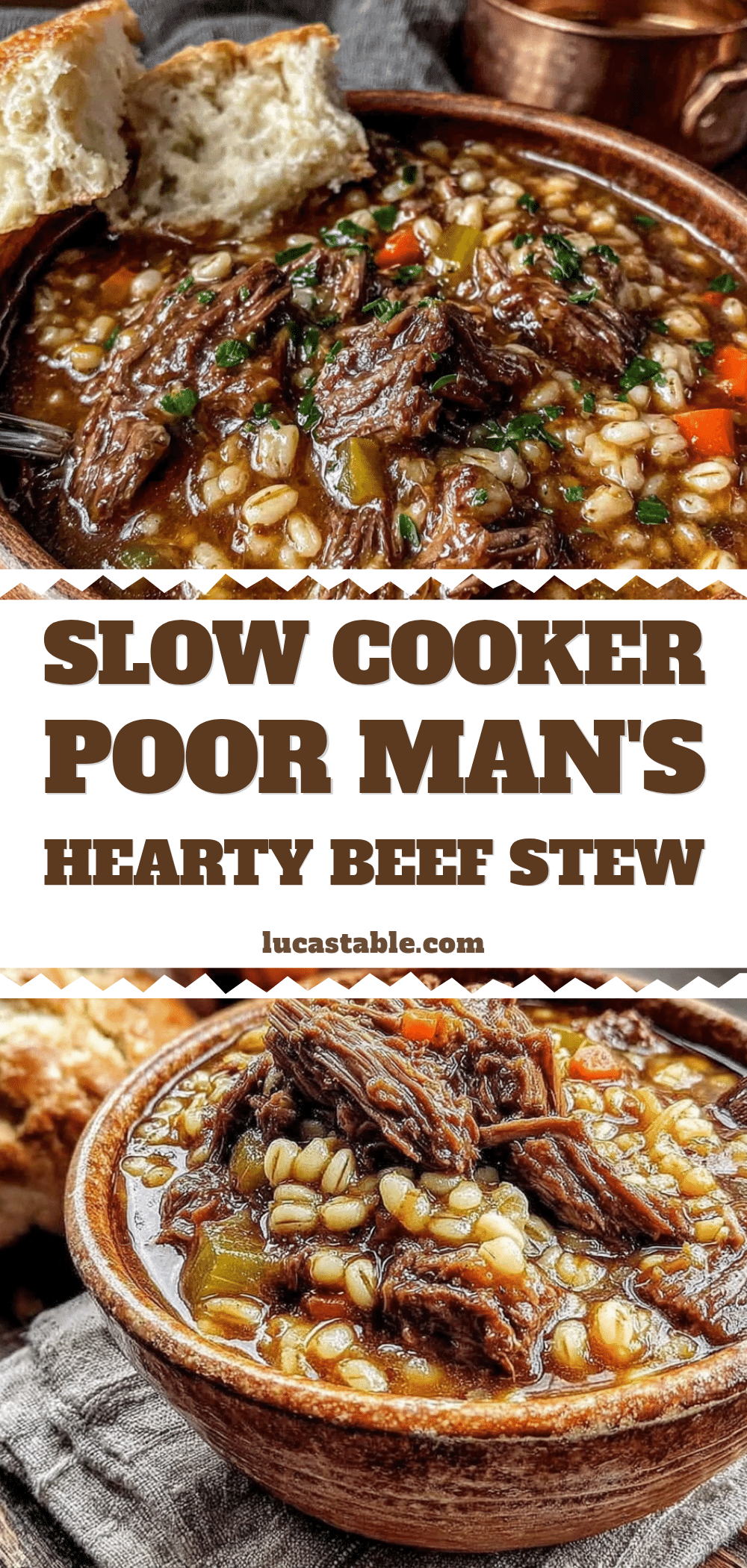
Cozy Slow Cooker Poor Mans Stew: Easy Beef and Barley
A hearty, budget-friendly slow cooker stew made with tender beef, pearl barley, and vegetables. It’s a set-it-and-forget-it meal that fills your home with comforting aromas and delivers deep, rich flavor without any fuss.
- Prep Time: 15 minutes
- Cook Time: 7-8 hours (low) or 4-5 hours (high)
- Total Time: 7 hours 15 minutes to 8 hours 15 minutes
- Yield: 6 servings 1x
- Category: Main Course
- Cuisine: American
Ingredients
- 2 lbs beef chuck roast, cut into 1.5-inch chunks
- 1 cup pearl barley, rinsed
- 1 large yellow onion, diced
- 3 medium carrots, peeled and sliced into rounds
- 3 stalks celery, sliced
- 4 cloves garlic, minced
- 4 cups low-sodium beef broth
- 2 cups water
- 2 tablespoons tomato paste
- 1 tablespoon Worcestershire sauce
- 1 teaspoon dried thyme
- ½ teaspoon dried rosemary
- 2 bay leaves
- 1 teaspoon salt (plus more to taste)
- ½ teaspoon black pepper (plus more to taste)
- 2 tablespoons olive oil
- Fresh parsley for garnish (optional)
Instructions
- Pat the chuck roast dry with paper towels. Cut into 1.5-inch chunks, trimming off large pieces of silver skin or hard fat. Season generously with 1 teaspoon salt and ½ teaspoon black pepper. Toss to coat evenly.
- Heat 2 tablespoons olive oil in a large skillet over medium-high heat until shimmering. Working in batches, add the beef chunks in a single layer and sear undisturbed for 3-4 minutes per side until a deep brown crust forms. Transfer browned beef to the slow cooker.
- Reduce heat to medium. Add diced onion to the same skillet and cook for 3-4 minutes until softened and translucent. Add minced garlic and cook for 30 seconds until fragrant, scraping up any browned bits from the pan. Transfer to the slow cooker.
- Add sliced carrots, celery, and rinsed pearl barley to the slow cooker. Stir to distribute evenly.
- In a separate bowl or large measuring cup, whisk together beef broth, water, tomato paste, Worcestershire sauce, dried thyme, and dried rosemary. Pour over the ingredients in the slow cooker. Add bay leaves, tucking them into the liquid. Ensure the barley is submerged.
- Cover and cook on LOW for 7-8 hours or on HIGH for 4-5 hours. About 30 minutes before serving, gently stir the stew. If too thick, add a splash of extra broth or water.
- Remove bay leaves and discard. Taste and adjust salt and pepper as needed. Ladle into bowls, garnish with fresh parsley if desired, and serve hot with crusty bread.
Notes
Don’t skip browning the beef—it’s crucial for flavor. Barley absorbs salt, so add salt gradually and adjust at the end. Use the low setting for best texture. Avoid lifting the lid during cooking. For extra flavor, toast the barley in a dry skillet for 2-3 minutes before adding. Leftovers taste even better the next day.
Nutrition
- Serving Size: 1 bowl (about 1.5 cu
- Calories: 450
- Sugar: 6
- Sodium: 800
- Fat: 16
- Saturated Fat: 5
- Carbohydrates: 38
- Fiber: 9
- Protein: 35
Keywords: slow cooker stew, beef and barley, poor man's stew, budget-friendly, comfort food, easy dinner, winter recipe