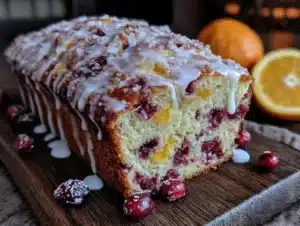
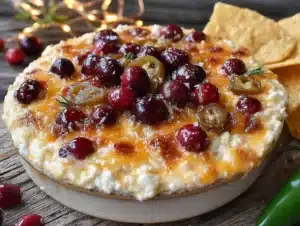
My neighbor showed up at my door at nine o’clock on a Tuesday night in December holding a carton of eggnog and looking apologetic. “I bought two by accident,” she said, shoving it into my hands. “Please take it.” I stood there in my fuzzy slippers, holding this random carton, already thinking about what on earth I was going to do with it. I’m not a big eggnog drinker, honestly. It’s thick and sweet and I can never finish a whole glass.
But I couldn’t let it go to waste. So I stuck it in the fridge and forgot about it for a day. Then Christmas morning panic set in. I had family coming over and no proper breakfast plan. That carton of eggnog was still sitting there, staring at me every time I opened the refrigerator door. And then it hit me—what if I used it like you’d use milk in a French toast casserole? (I know, it sounds obvious now, but at the time I felt pretty clever.)
So I grabbed a loaf of brioche that was getting a little stale, whisked together the eggnog with some eggs and vanilla, and threw it all in a baking dish before going to bed. The next morning, I baked it off while everyone was opening presents. The smell alone had people wandering into the kitchen with that dazed, hungry look. And when I pulled that golden, puffed-up casserole out of the oven? Let’s just say nobody missed the store-bought cinnamon rolls I had stashed in the freezer as a backup plan.
This easy eggnog French toast casserole (overnight) has become my official Christmas morning tradition. It’s the kind of recipe that makes you look like you planned something elaborate when really you just got lucky with a neighbor’s extra grocery purchase.
Why You’ll Love This Recipe
Let me tell you why this overnight eggnog French toast casserole is about to become your new holiday hero. I’ve tested this recipe about six times now (tough job, I know) and tweaked it until it was just right.
- Prep It the Night Before : You do all the work the night before, so Christmas morning is just about popping it in the oven and enjoying your coffee. No standing over a skillet flipping individual slices of French toast while everyone waits.
- Simple Ingredients : You probably already have most of what you need. Eggs, bread, butter, sugar. The eggnog is the special guest star, but everything else is pantry basics.
- Perfect for Holiday Mornings : This is made for Christmas Eve prep and Christmas morning chaos. It feeds a crowd without any fuss.
- Crowd-Pleaser : I’ve served this to kids, adults, and even my picky uncle who “doesn’t like sweet breakfasts.” He went back for seconds. (He said it was “acceptable.” That’s high praise from him.)
- Unbelievably Delicious : The texture is what gets me every time. The top gets slightly crisp and caramelized while the inside stays soft and custard-like. It’s basically breakfast bread pudding, and who doesn’t love that?
What makes this version different from all the others? It’s the way the eggnog infuses every single bite with that warm, spiced flavor without being overwhelming. I played around with the ratio of eggnog to eggs until I found the sweet spot where the casserole sets up perfectly without being too wet or too dry. It’s not just another French toast casserole—it’s the one that makes people ask for the recipe before they’ve even finished their first serving.
This recipe is the kind that makes you close your eyes after the first bite. It’s comfort food reimagined for the holidays—rich and indulgent, but somehow not heavy. Perfect for impressing overnight guests without any stress, or turning a regular Saturday morning into something special.
What Ingredients You Will Need
This recipe uses simple, wholesome ingredients to deliver that rich, custardy texture and warm holiday flavor. Most of these are probably already in your kitchen, minus the eggnog itself.
- 1 loaf (about 14-16 ounces) day-old brioche or challah bread : Stale bread is actually better here because it soaks up the custard without turning into complete mush. If your bread is fresh, just leave it out on the counter for a few hours or pop it in a 300°F oven for 5-7 minutes to dry it out slightly. I prefer brioche for its buttery richness, but challah works beautifully too.
- 2 cups eggnog : This is the star of the show. Use store-bought or homemade—both work great. I’ve tested this with both full-fat and low-fat eggnog, and honestly, full-fat gives you a much creamier result. (The low-fat version was a little thin for my liking.)
- 4 large eggs : Room temperature eggs mix more evenly into the custard. If you forgot to take them out ahead of time, just place them in a bowl of warm water for 5 minutes.
- 1/4 cup granulated sugar : Just enough to sweeten things up without making it cloying. The eggnog already has sugar in it, so we don’t need much.
- 1 teaspoon vanilla extract : Pure vanilla extract makes a difference here. I’ve used imitation in a pinch, and it works, but the real stuff adds a depth of flavor that’s worth it for a holiday breakfast.
- 1/2 teaspoon ground cinnamon : Most eggnog already has cinnamon in it, but I like to add a little extra for warmth.
- 1/4 teaspoon ground nutmeg : Freshly grated nutmeg is amazing if you have it. The pre-ground stuff works fine too.
- 1/4 teaspoon salt : Don’t skip this! Salt balances the sweetness and enhances all the other flavors.
- 2 tablespoons unsalted butter, melted : For brushing the baking dish and dotting on top before baking. It helps create that golden, slightly crispy top.
For the topping (optional but highly recommended):
- 2 tablespoons brown sugar : Sprinkled on top before baking for a caramelized crust.
- 1/4 cup chopped pecans or walnuts : Adds a nice crunch. Toast them lightly first for extra flavor.
- Powdered sugar for dusting : Makes it look pretty and adds a touch of sweetness.
- Maple syrup for serving : Because is it really French toast without maple syrup?
One ingredient tip I learned the hard way: don’t use low-fat or “light” eggnog. The texture just isn’t the same. The casserole needs that richness to set up properly. I made that mistake once when I was trying to be “healthy” during the holidays, and the result was a watery, sad casserole that nobody wanted to eat. Learn from my mistakes, friends.
Equipment Needed
You don’t need anything fancy for this recipe. Here’s what you’ll need:
- 9×13-inch baking dish : This is the standard size for this recipe. A ceramic or glass dish works best because it heats evenly. I use a Pyrex dish that’s seen better days but still does the job.
- Large mixing bowl : For whisking together the custard mixture. Any large bowl will do.
- Whisk : A good whisk makes mixing the eggs and eggnog smooth and lump-free.
- Measuring cups and spoons : For accurate measurements. I know some people eyeball it, but for a custard-based recipe, precision matters.
- Sharp knife and cutting board : For cubing the bread. A serrated bread knife works best for brioche or challah.
- Aluminum foil : For covering the dish while it bakes initially, then removing for the last part to get that golden top.
- Plastic wrap or lid : For covering the dish overnight in the refrigerator.
If you don’t have a 9×13 dish, you can use two smaller dishes or even a round 10-inch baking dish. Just keep an eye on the baking time as it might vary slightly. I’ve also made this in individual ramekins for a fancy brunch presentation, and it worked great—just reduce the baking time to about 20-25 minutes.
Preparation Method
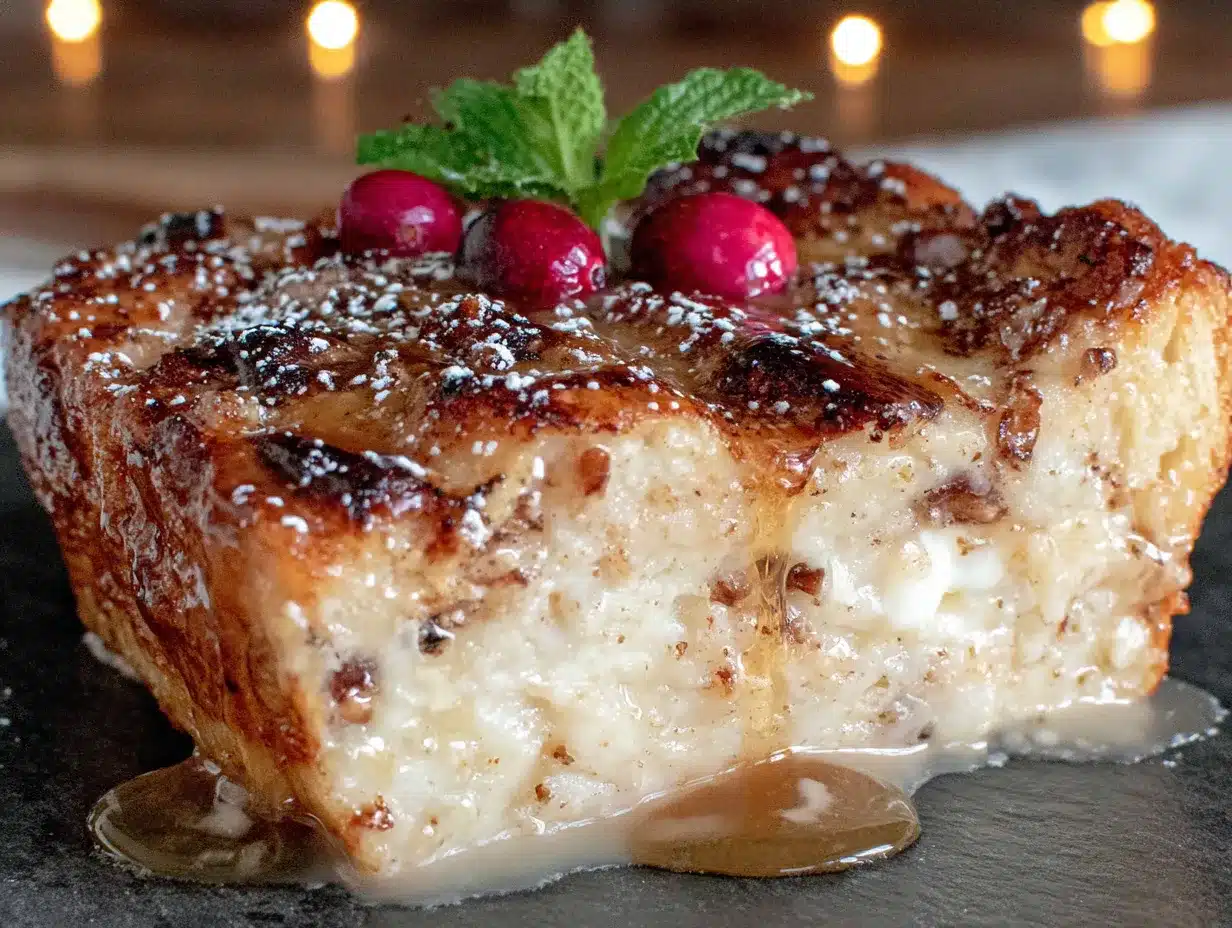
This overnight eggnog French toast casserole comes together in two easy stages. Here’s how to do it:
Step 1: Prep the Bread (5 minutes)
Cut your loaf of brioche or challah into 1-inch cubes. Don’t stress about making them perfect—rustic, uneven pieces are fine and actually help create texture. Spread the bread cubes evenly in your greased 9×13 baking dish. I like to let them sit out for about 10 minutes while I make the custard so they dry out a little more.
Step 2: Make the Custard (5 minutes)
In your large mixing bowl, whisk together the 2 cups of eggnog, 4 large eggs, 1/4 cup granulated sugar, 1 teaspoon vanilla extract, 1/2 teaspoon cinnamon, 1/4 teaspoon nutmeg, and 1/4 teaspoon salt. Whisk until everything is completely combined and smooth. You want the eggs to be fully incorporated—no streaks of egg white floating around.
Step 3: Assemble the Casserole (5 minutes)
Pour the custard mixture evenly over the bread cubes in the baking dish. Gently press down on the bread with a spatula or your hands to make sure every piece gets soaked. Don’t worry if it looks like too much liquid at first—the bread will absorb it as it sits. Cover the dish tightly with plastic wrap and place it in the refrigerator for at least 4 hours, but preferably overnight (8-12 hours). This is where the magic happens.
Step 4: Bake the Casserole (45-55 minutes)
The next morning, take the dish out of the refrigerator about 20 minutes before baking to let it come to room temperature. Preheat your oven to 350°F (175°C). Remove the plastic wrap and brush the top with the melted butter. Sprinkle the brown sugar and chopped nuts evenly over the top if you’re using them.
Cover the dish with aluminum foil and bake for 30 minutes. Then remove the foil and bake for another 15-25 minutes, until the top is golden brown and the center is set. You’ll know it’s done when the casserole is puffed up and a knife inserted in the center comes out clean. The edges should be slightly caramelized and the top should be beautifully golden.
Step 5: Rest and Serve (10 minutes)
Let the casserole rest for about 10 minutes after it comes out of the oven. This helps it set up and makes it easier to cut into squares. Dust with powdered sugar and serve warm with maple syrup on the side.
A few things I’ve learned from making this multiple times: First, don’t rush the soaking time. The bread really needs those hours to absorb the custard properly. Second, if you’re in a hurry, you can skip the overnight soak and just let it sit for an hour at room temperature, but the texture won’t be as good. And third, if the top is getting too brown before the center is set, just cover it back up with foil for the remaining baking time.
Cooking Tips & Techniques
After making this recipe more times than I care to count, I’ve picked up a few tricks that make a real difference.
Use stale bread. This is the number one tip I tell everyone. Fresh bread turns into a soggy mess because it doesn’t have the structure to hold up to all that liquid. Day-old bread is ideal, but if your bread is fresh, just cube it and spread it on a baking sheet in a 300°F oven for 5-7 minutes. You want it slightly dried out but not toasted.
Don’t overmix the custard. Whisk just until the eggs are broken up and everything is combined. Overmixing incorporates too much air, which can make the casserole puff up too much in the oven and then collapse. It’ll still taste fine, but the texture won’t be as nice.
Press the bread down. After you pour the custard over the bread, use a spatula to gently press the bread down so every piece gets soaked. Some pieces will float to the top—that’s fine. Just give them a gentle push.
Let it rest after baking. I know it’s hard to wait when your kitchen smells like Christmas and everyone is hovering, but that 10-minute rest is crucial. The casserole continues to set as it cools slightly, and cutting into it too soon will give you a messy, soupy result.
One mistake I made the first time was using a metal baking dish. The casserole cooked unevenly and the edges got too dark before the center was done. Stick with glass or ceramic if you can. And if you’re doubling the recipe (which I often do for big family gatherings), use two separate 9×13 dishes rather than one giant one—it bakes much more evenly.
Variations & Adaptations
This recipe is super forgiving and adaptable. Here are some variations I’ve tried and loved:
Gluten-Free Version : Use a good-quality gluten-free bread, preferably something sturdy like a gluten-free brioche or sourdough. Let it dry out completely before using. I’ve tested this with a few different brands, and it works surprisingly well. Just keep in mind that gluten-free bread tends to absorb liquid faster, so you might need slightly less custard.
Dairy-Free Version : Substitute the eggnog with a dairy-free eggnog (there are some great ones on the market now) and use a plant-based butter. The texture will be slightly different, but it’s still delicious. I tried this with a coconut milk-based eggnog once, and it added a lovely subtle coconut flavor that paired nicely with the spices.
Boozy Adult Version : Add 2 tablespoons of dark rum or bourbon to the custard mixture. The alcohol mostly cooks off, but it leaves behind a warm, complex flavor that’s perfect for holiday mornings. (Just make sure everyone eating knows it’s in there.)
Fruit Addition : Layer in some fresh or frozen berries between the bread cubes before adding the custard. Cranberries are especially festive and add a nice tart contrast to the sweet custard. I’ve also used sliced pears and apples, which soften beautifully as they bake.
Make It a Brunch Centerpiece : Top the baked casserole with a drizzle of caramel sauce, a dollop of whipped cream, and a sprinkle of cinnamon. It turns a simple breakfast into a showstopper brunch dish that looks like you spent hours on it.
One of my favorite variations is adding a layer of cream cheese cubes to the bread before pouring the custard. The cream cheese melts into little pockets of tangy richness throughout the casserole. It’s ridiculous in the best way.
Serving & Storage Suggestions
This casserole is best served warm, straight from the oven. I like to let it rest for 10 minutes, then cut it into squares and serve with warm maple syrup on the side. A dusting of powdered sugar makes it look extra pretty, and a few fresh berries on the plate add a pop of color.
For a full holiday brunch spread, I pair this with some crispy bacon or breakfast sausage on the side. The salty, savory meat balances the sweetness of the casserole perfectly. Fresh fruit salad is also a nice addition, and a pot of strong coffee is non-negotiable in my house.
Storage: Leftovers keep well in the refrigerator for up to 3 days. Just cover the dish tightly with plastic wrap or transfer individual portions to airtight containers. The texture does soften a bit over time, but it’s still delicious.
Reheating: The best way to reheat this is in the oven at 300°F for about 10-15 minutes. It helps restore some of the crispy top. You can also use the microwave in a pinch, but the texture will be softer. For individual portions, the microwave works fine for 30-45 seconds.
Freezing: You can freeze the unbaked casserole! Assemble it in the dish, cover tightly with plastic wrap and then foil, and freeze for up to 3 months. When you’re ready to bake, thaw it overnight in the refrigerator and then bake as directed. I’ve also frozen baked leftovers—just wrap individual portions in plastic wrap and foil, then reheat in the oven when you’re ready.
One thing I’ve noticed is that the flavors actually get better after a day in the fridge. The spices meld together and the custard sets up even more. So don’t be sad if you have leftovers—they’re almost better the next day.
Nutritional Information & Benefits
Let’s be real—this is a holiday indulgence, not a health food. But here’s the estimated nutritional breakdown per serving (based on 8 servings):
- Calories: 380-420
- Fat: 18-22g
- Carbohydrates: 42-48g
- Protein: 12-15g
- Sugar: 22-28g
- Sodium: 380-420mg
That said, there are some redeeming qualities. The eggs provide high-quality protein and important nutrients like choline and vitamin D. The eggnog (if you use a good quality one) contains calcium and vitamin A. And the nuts on top add healthy fats and a little fiber.
If you’re watching your sugar intake, you can reduce the added sugar in the custard to 2 tablespoons and skip the brown sugar topping. The eggnog itself is sweet enough to carry the dish. I’ve also made this with a sugar-free eggnog alternative, and while it wasn’t quite as rich, it was still pretty satisfying.
As always, this recipe contains dairy, eggs, gluten (unless you use gluten-free bread), and nuts (if you add the topping). Adjust accordingly for your dietary needs.
Conclusion
This easy eggnog French toast casserole (overnight) has become my go-to holiday breakfast for good reason. It’s simple enough for a lazy Saturday morning but impressive enough for Christmas brunch with the whole family. The best part? You do all the work the night before, so you can actually enjoy your morning instead of stressing in the kitchen.
I love that this recipe is so forgiving and adaptable. Whether you’re feeding a crowd or just want a special breakfast for yourself, it delivers every time. And honestly, there’s something magical about waking up to a breakfast that’s already prepped and ready to go. It makes the whole morning feel like a gift.
I’d love to hear how this turns out for you! Did you add any fun variations? Serve it with something unexpected? Leave a comment below and let me know—I read every single one and I love hearing about your kitchen adventures.
So go grab that carton of eggnog, dig out your baking dish, and treat yourself to a breakfast that’ll make your whole house smell like Christmas morning. You deserve it.
Frequently Asked Questions
Can I make this without eggnog?
Technically yes, but then it’s just regular French toast casserole. If you don’t have eggnog, you can substitute with a mixture of milk, heavy cream, and extra spices (cinnamon, nutmeg, cloves). But honestly, the eggnog is what makes this recipe special, so I’d recommend picking up a carton.
Can I use a different type of bread?
Absolutely! While brioche and challah are my favorites, you can use French bread, sourdough, Texas toast, or even croissants. Just avoid super soft sandwich bread, as it tends to get too mushy. Sturdier breads hold up better to the custard.
Can I skip the overnight soak?
You can, but I wouldn’t recommend it. The overnight soak allows the bread to fully absorb the custard, which gives you that soft, pudding-like interior. If you’re short on time, let it sit for at least 2-3 hours at room temperature. Even an hour is better than nothing, but the texture won’t be as good.
How do I know when the casserole is fully baked?
The casserole is done when the top is golden brown and the center is set. You can test it by inserting a knife into the center—if it comes out clean, it’s done. The edges should be slightly puffed and caramelized. If the top is browning too quickly, just cover it with foil for the remaining baking time.
Can I double this recipe?
Yes! If you’re feeding a crowd, double all the ingredients and use two 9×13 baking dishes. Don’t try to fit everything into one dish, as it won’t bake evenly. I’ve made this for Christmas brunch with 12 people and it was a huge hit. Just make sure you have enough refrigerator space for both dishes to soak overnight.
Pin This Recipe!
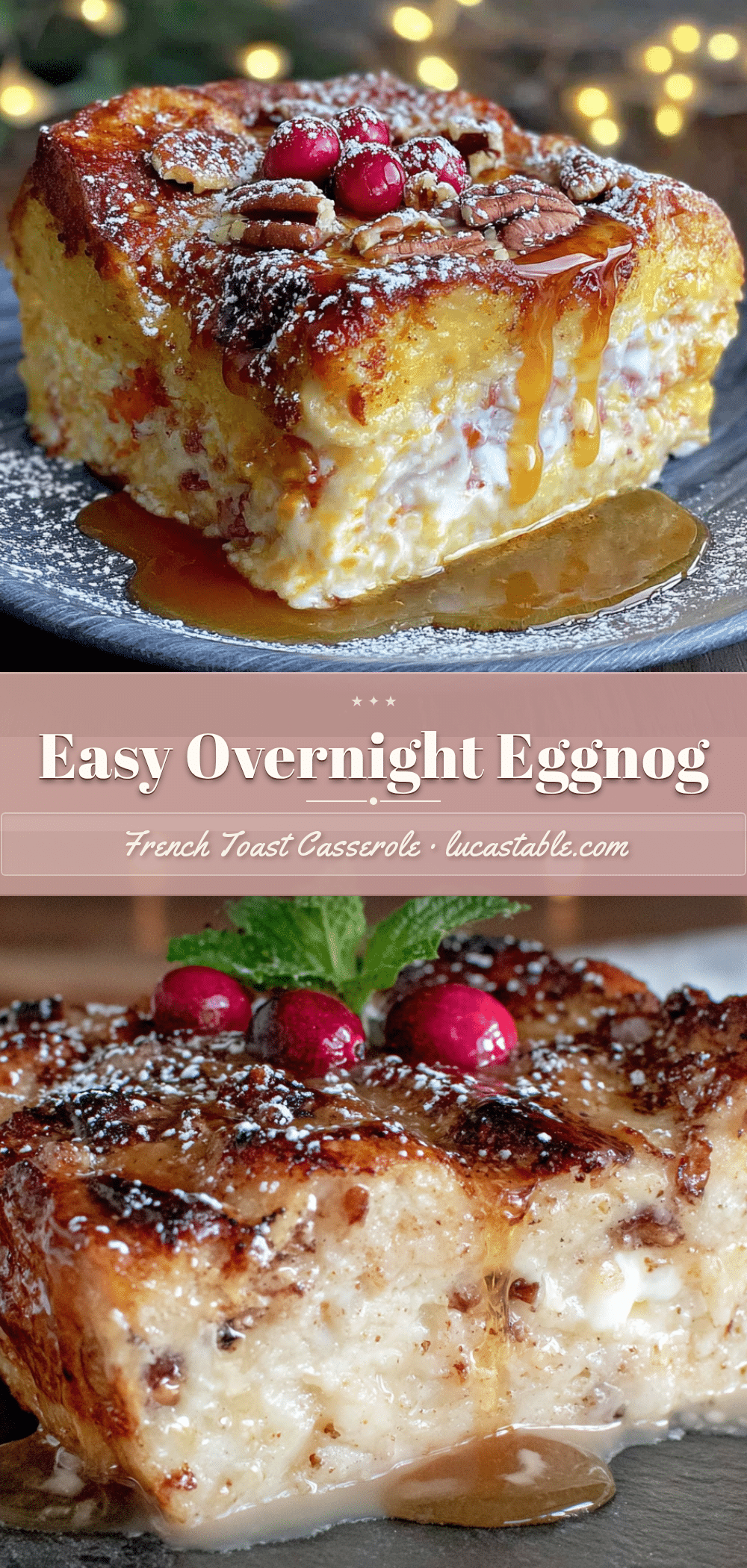
Easy Eggnog French Toast Casserole (Overnight) – Best Holiday Recipe
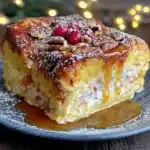
This easy overnight eggnog French toast casserole is the perfect holiday breakfast. Prep it the night before, then bake it in the morning for a golden, custard-like dish that feeds a crowd with minimal fuss.
- Prep Time: 15 minutes
- Cook Time: 45-55 minutes
- Total Time: 8 hours 15 minutes (including overnight soak)
- Yield: 8 servings 1x
- Category: Breakfast / Brunch
- Cuisine: American
Ingredients
- 1 loaf (14-16 ounces) day-old brioche or challah bread, cut into 1-inch cubes
- 2 cups eggnog (full-fat recommended)
- 4 large eggs, room temperature
- 1/4 cup granulated sugar
- 1 teaspoon vanilla extract
- 1/2 teaspoon ground cinnamon
- 1/4 teaspoon ground nutmeg
- 1/4 teaspoon salt
- 2 tablespoons unsalted butter, melted
- 2 tablespoons brown sugar (for topping, optional)
- 1/4 cup chopped pecans or walnuts (for topping, optional)
- Powdered sugar for dusting (optional)
- Maple syrup for serving (optional)
Instructions
- Cut the brioche or challah bread into 1-inch cubes and spread evenly in a greased 9×13-inch baking dish. Let sit for 10 minutes to dry out slightly.
- In a large mixing bowl, whisk together the eggnog, eggs, granulated sugar, vanilla extract, cinnamon, nutmeg, and salt until smooth and fully combined.
- Pour the custard mixture evenly over the bread cubes. Gently press down on the bread with a spatula to ensure all pieces are soaked. Cover tightly with plastic wrap and refrigerate for at least 4 hours, preferably overnight (8-12 hours).
- The next morning, remove the dish from the refrigerator and let it sit at room temperature for 20 minutes. Preheat the oven to 350°F (175°C).
- Remove the plastic wrap and brush the top with melted butter. Sprinkle brown sugar and chopped nuts evenly over the top if using.
- Cover the dish with aluminum foil and bake for 30 minutes. Remove the foil and bake for another 15-25 minutes, until the top is golden brown and the center is set (a knife inserted in the center should come out clean).
- Let the casserole rest for 10 minutes before serving. Dust with powdered sugar and serve warm with maple syrup on the side.
Notes
Use stale or day-old bread for best texture. If bread is fresh, dry it out in a 300°F oven for 5-7 minutes. Don’t rush the soaking time; overnight is ideal. If the top browns too quickly, cover with foil for remaining baking time. Let rest 10 minutes after baking before cutting. Leftovers keep in the refrigerator for up to 3 days; reheat in a 300°F oven for 10-15 minutes. The unbaked casserole can be frozen for up to 3 months.
Nutrition
- Serving Size: 1 square (1/8 of cas
- Calories: 380420
- Sugar: 2228
- Sodium: 380420
- Fat: 1822
- Saturated Fat: 810
- Carbohydrates: 4248
- Fiber: 23
- Protein: 1215
Keywords: eggnog french toast casserole, overnight french toast casserole, holiday breakfast, christmas breakfast, eggnog recipe, french toast bake, brunch casserole